I want you here I ache for us to be (stupid) together lost (in each other) arms around each other on the metro stolen kisses that taste like wine stretching to clinging impropriety
stumbling off the train giggling, hurrying, impatient to close that hotel room door for hands on skin for cool sheets and warm lips for sighs for gasps that mean things
your hands on my hips your mouth on my throat my fingers in your hair crazy (stupid) drunk on love/lust/wanting
bookstore secrets taste different at this time of night
This is a painful topic to visit, but I think perhaps it is time to bring it out into the open. For as long as I can remember, I have never felt “good enough.” Perfectionism. Impostor syndrome. Depression. Anxiety. Overachiever. That wound by any other name still hurts. A lot. I’ve thought wryly that I’m even an overachiever at feeling not good enough — the mantra “I am good enough,” for example, is not at all soothing or affirming for me. In truth, it grates on me. I don’t want to be just good enough, I want to be the best. At everything. To everyone. The favorite. The winner. Perfect.
Introspection and a couple really excellent therapists have made me wonder if I actually want to be those things, or if I feel like I need to be them. It is, of course, the latter. And yet, how do I let this need go? We could start with logic, perhaps:
Perfection is impossible.
I cannot be the best at everything.
I cannot be everyone’s favorite person.
And to try to be or do any of these is not only impossible, it is exhausting. I have set myself up to fail (which is somehow also one of my greatest fears — failure. Being a perfectionist is hard, y’all!). Not everyone will even like me. And that’s okay.
Unfortunately, though, logic is rarely as helpful as we want it to be when confronting one’s demons. I don’t yet have all the answers to healing this core wound, but bringing it into the light is a good first step. I am lucky enough to have wonderful, loving people in my life to reassure me when I need it, and sometimes when I don’t, which is so beautiful. Cognizance and kindness are two things buoying me as well: awareness of these woundings, and the gentleness I can offer myself when they arise. And while I walk this road to healing, the immortal words of Mary Oliver are ever a comfort. I hope they can be for you as well.
WILD GEESE by Mary Oliver
You do not have to be good. You do not have to walk on your knees for a hundred miles through the desert repenting. You only have to let the soft animal of your body love what it loves. Tell me about despair, yours, and I will tell you mine. Meanwhile the world goes on. Meanwhile the sun and the clear pebbles of the rain are moving across the landscapes, over the prairies and the deep trees, the mountains and the rivers. Meanwhile the wild geese, high in the clean blue air, are heading home again. Whoever you are, no matter how lonely, the world offers itself to your imagination, calls to you like the wild geese, harsh and exciting – over and over announcing your place in the family of things.
what is the difference between spilling over and spilling open?
is the glass half full? no, it’s full — to the very brim, a rim that somehow holds me together and pulls me to the brink, a ledge to cling to or leap from
somehow too much and yet still not enough to break through or break down
a bountiful overflowing of emotion and self that some(one) can’t wait to sop off the table
whisk it away blot it up hide the mess out of sight, out of mind
but you can still see the stain — see how it spreads and changes? see how the blood/wine crimson looks like flowers?
I had the privilege of attending a book talk and signing for Maggie Smith’s memoir You Could Make This Place Beautiful at Vroman’s Bookstore in Pasadena recently, with the discussion led by fellow poet Jennifer Pastiloff. I was struck by an overwhelming sense of female camaraderie in the room that evening that was so beautiful, it made me ache. (In no small part it was also thanks to my dear friend Molly who accompanied me.)
Guided by Pastiloff’s excellent questions, Smith touched on several topics, starting with being “bored with genre.” “I don’t need to classify something to make it,” she stated, setting her memoir free from genre in that quietly confident way of hers. It is a memoir, yes, but also a meditation of sorts. An unspooling. And always, always poetry.
On boundaries: “I built it my way and then I needed to be able to shepherd it into the world my way as well, in a way I could make livable.” Smith was touchingly open about her struggles with being seen as her memoir debuted. It chronicles a difficult period in her life that included — but certainly was not limited to — her divorce, and the reckoning in it’s unfurling and aftermath. For a poet who is used to the distance afforded by being The Narrator, being herself in all her raw glory was a new and painfully exposed way to be seen. Thank you, Maggie, for your courage and your willingness to be vulnerable. We have this beautiful unspooling corkscrew of musings thanks to your willingness to share, be open, and give us your “tell-mine” of a book.
On being ‘good’: “Part of being good is being liked, so what happens when you do something that makes you unlikeable?” Smith and Pastiloff both posed this question, one the question of being “bad” and the other of being “good,” both asking the same thing in the end. Are we bad people when we try to find our way to something different? What does being “good” mean for us? For women it means being likeable. Pleasant. Pliant. What happens when we choose not to be?
On perspective: “How did I let myself become so small? How did I let my writing become so small?” As women, it is almost as though we need permission to make ourselves and our work — our true creative work, not just our jobs — priorities. It is sinuous and slippery, this insidious expectation that we often don’t realize is there until a sudden shift in perspective allows us to see how small in our own lives we have truly become. It is a reckoning, but also, a light if we let it be. “I was looking for permission to do something a different way,” mused Smith. What if the only one we need permission from is ourselves?
Smith’s memoir is as poetic as you’d expect, lyrical and sharply observed by turns, musing and marvelous. Pick up a copy today, pick up a metaphorical lantern, and walk with her a while. You won’t be sorry you did.
I wrote this poem a few years ago, on a day when my depression seemed to be swallowing me whole. Some days I come back to this feeling for a while, especially when an emotional lifeboat seems difficult to find.
sinking slowly kicking back to the surface over and over and over again until she tires of treading, ever-treading
gently she sinks, lips pressed together in a hard line until she rests at the bottom where no one can tell the difference between errant tears and the waters in which she resides
crumpled and frayed, perhaps she can learn to unfurl to sway like the graceful kelp that stretches upwards toward the sun, but for now, she cannot even open her eyes, or imagine that somewhere there is light and warmth and sunshine
the pressure becomes a comfort — something to hold her pieces together, something to keep her from flying apart, to keep her from dissolving into the aether above — because it would be so much easier to cease to be, so much easier for sentience to become scattered stardust
Last night I read a book that I could have written. Lyric and melancholy, musing, yearning, seeking — philosophical, if you will.
Today’s book, the pages are full of you, have you all over them. A novel of tight, clipped prose. Simple. Deceptively so. Something new for me to touch that feels all too familiar.
Maybe somewhere these books are on a shelf, touching in ways that we cannot seem to no matter how much I ache.
I stayed with you that summer, loving you from the far end of your couch cup of tea in my palms and a welcoming smile on my lips that I hoped could cross the gulf between us.
Later we imploded, but in my heart I still carry the softness of that early morning light and your shirt even softer on my cheek.
some fruits wither and fall away so that others can flourish and ripen and burst open when it is their season
do not mourn the harvest that could have been when a bounty of sweetness was/is/will be exploding on your tongue even now in this very moment alive with every possibility
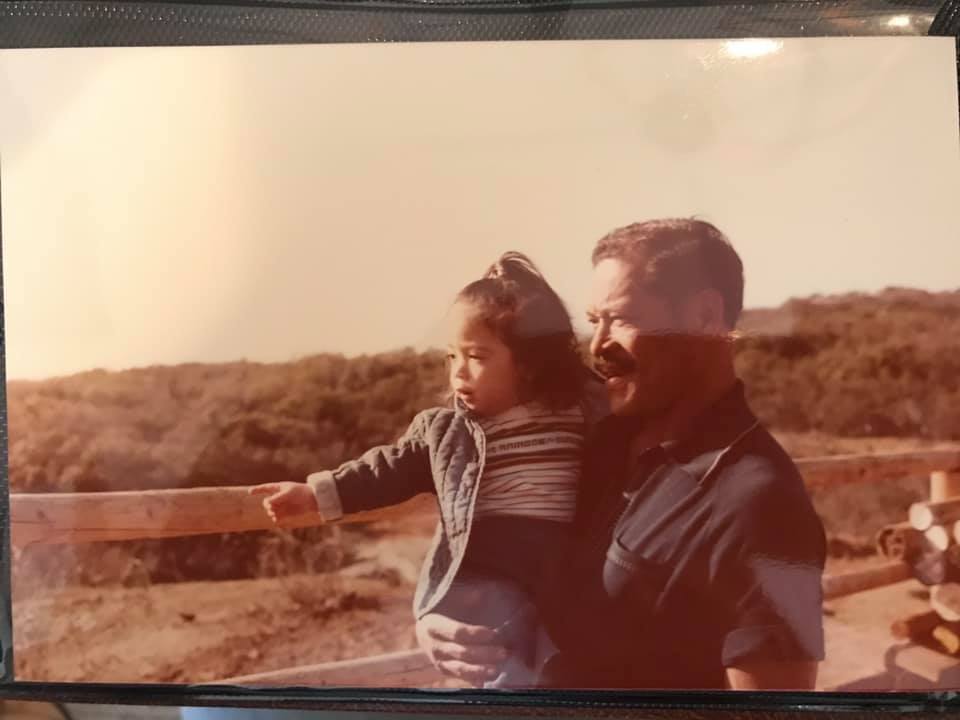
Yesterday my dad passed away. He was 88 years old. I sat there listening to my half-brother cry on the other end of the line as he delivered the news, stunned and numb for what felt like an eternity. Then I burst into tears.
My dad had the most fascinating, full life anyone could imagine, from growing up in Trinidad and a youthful sojourn in the merchant marines, working as a psychiatric nurse and a double decker bus driver in Scotland, and then emigrating to the U.S. even though he was barred entry here for years due to his Chinese heritage. He worked as a self-employed mechanic, raised two families, and loved his children fiercely. He was generous, loved going to the horse races (where I spent many a happy summer in the infield), was an excellent cook, and entertained us with Charlie-isms like “throosers” for trousers, “DOHg” for dog, and the very British “alumEEnium.” To this day I don’t know how much these quirks of speech were a result of 3 continents’ worth of accents, or how much they were his own little idiosyncrasies. We loved it either way. Most summers he spent a little time “up north” mining for gold with friends, he was a great bowler and miniature golfer, and he left this world on his own terms – independent, living on his own, and old enough see his oldest grandchild start high school, just like he wanted.
I wrote this poem a few years ago for him, when he was having one of his many health scares. I didn’t share it with him at the time, though. He was so very afraid of dying, and I thought the allusions to it in my poem would be troubling for him as he convalesced. I finally gave him a framed copy of it for Father’s Day this year, and I think it may have been his favorite gift I ever gave him. To say he loved it would be an understatement — he held it and read it over and over, mouthing the words and cradling the frame gently in his arthritic hands. He marveled that I had written it “all on my own,” and said I had “brought a tear to his eye,” — but I already knew. I could see the tears shining there. He told me almost shyly that he wanted to try to memorize it, even though his memory had gotten so much worse over the years. I was honored and so, so humbled. That was our last visit, and I am so grateful I was able to convey to him just how loved he was before he died.
father/time

so passes
the golden autumn
of this world
into a dark/light place
made of lengthening shadows
and warm tender moments alike.
poignant relief marks the passing
of each second and season,
pearls on a string slipping away
through fingers
roughened by time,
all the more cherished
for that which has gnarled them.
fear not,
though a shadow passes over your eyes
at the thought
of things unknown.
in the end,
you are loved.
— Charla M. DelaCuadra
I love you, Daddy, and I miss you already. I’ll always be grateful for your love. I know you were proud of me. I share your name, and you’ll always be in my heart. Thank you — for everything.




 Pink&GreenMusings