“This is the first time the girl becomes aware that the world requires something other than what she is.”
–Lesley Nneka Arimah, What It Means When a Man Falls From the Sky: Stories
This Friday I am thinking about expectations, and about balance. The world might expect something different than what we are or what we want, but that doesn’t mean we are obligated to give in to that expectation. Find your bliss, find your fulcrum, and don’t let the world upset the balance you find.
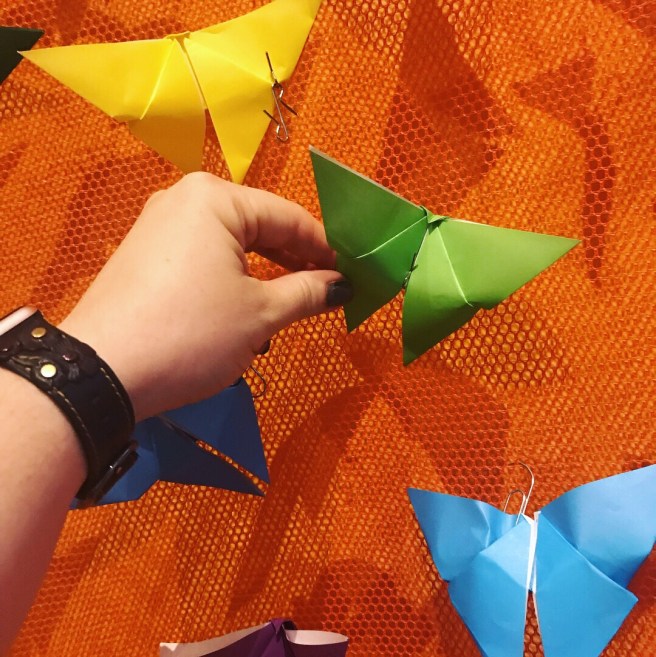
My visit to the Metamorphosis & Migration exhibit, Oakland Museum of California.
Yesterday on Cup of Jo, the fantastic Caroline Donofrio wrote about a five-word quote that she said changed her life: “Cool is an emotional straightjacket.”
Whoa. Whoa. That really got me thinking. It really is. How often do we censor ourselves for fear of what other people will think about us? Maybe it is reining in enthusiasm about an interest that isn’t “cool enough,” or swallowing a sentiment because we feel obligated to “play it cool.” Maybe it is putting down other women to seem like the “cool girl.” Or maybe it is putting that favorite sweater/jacket/scarf/hat/whatever back in the closet with a sigh, wishing it were still “cool.”
The prospect of living my life in an invisible straightjacket seems terribly sad. We are bombarded by admonitions to just “be yourself,” to “live authentically.” But what does this mean? I like to think I am forging my own path. But when I get dressed in the morning, when I chime into a conversation, when I choose the restaurant for a group night out? I’d be lying if I said I didn’t want the approval of others.
Perhaps this is a part of that ever-elusive self-care: to truly allow ourselves to be. Be unique, be freer with our affections, be engrossed by the things that make us smile, be supportive of our fellow women without fear of not being “cool enough,” be unencumbered by what we think is expected of us in a million tiny ways. Of course, this is an enormously difficult task. But by recognizing this propensity for what it is rather than move invisibly constricted through our days , we can make an important first step. Recognize that second-guessing, recognize the holding back, and act accordingly.
Caroline closes with his gem: “After all, the opposite of cool… is warm. Doesn’t that sound nice?” It does, Caroline. It really does.
Being a perfectionist with anxiety is a difficult combination. For years I thought procrastination was a bad habit I couldn’t seem to kick. Recently, though, I have realized it is more of a symptom than a bad habit. I habitually worried so much about whether I’d truly be able to do my best, and whether that best would be good enough, that I put things off until the fear of complete failure eclipsed the fear of “not good enough.” Ta-da! Last minute, there I was. Stressed and harried, procrastinator extraordinaire.
I am starting to teach myself that sometimes, good enough is just fine. The old adage of “just do your best” can be problematic for me because I always think I can do it a little better. Was this my best? Not quite, I should work harder. Put more time into it. Stop being so lazy and do more. It wouldn’t end. The negative feedback loop was on repeat, all the time. So now I am learning that some days I am inspired, and most days I can put forth excellent work. But if I am having an off day, it is okay. Putting one foot in front of the other is better than freezing into perfection-induced paralysis, because then I am still making progress. And if I am having a really bad day, that is okay, too. We can’t be full speed ahead, all the time, every day. The world has seasons and rhythms and so do we. I read an article last month that keeps coming to mind — how winter is a great reminder to give yourself permission to slow down — and I’ve been trying to take that to heart. Slowing down sometimes is okay. Stopping to recharge sometimes is not only okay, but necessary. Huh. How novel, right?
We can be our own worst critics more often than not. I seem to be very good at reminding friends and the people I care about to slow down and take good care of themselves, and not very good at treating myself with the same care. “Treat yourself the way you would a good friend” seems a bit trite, but it is more difficult than one might think! Would I berate a friend for being too tired at the end of the day to take on an extra project? Of course not. Would I call them lazy and tell them to put in more effort when they are already doing good things? Never. Perhaps it is time we all give ourselves some gentleness. Our society seems built on more-better-harder-faster, which can make it difficult. But the world needs more kindness right now, and starting with oneself can be a quietly revolutionary thing, indeed.


 Pink&GreenMusings